Discussion Questions for Economic Article Review in Forbes
Top 12 Exam Questions and Answers on Economics
Article Shared by 
Exam questions and answers on economics!
Exam Question # Q.1. How does Managerial Economics Differ from Economics?
Ans. i. Whereas managerial economics involves awarding of economic principles to the problems of the business firm, Economics deals with the body of the principles itself.
ii. Whereas managerial economic science is micro-economical in graphic symbol economics is both macro-economical and micro-economic.
three. Managerial economics, though micro in grapheme, deals merely with the firm and has nothing to practise with an individual's economic problems. Just micro economic science as a branch of economic science deals with both economics of the individual besides as economic science of the business firm.
4. Under micro-economics as a co-operative of economics, distribution theories, viz., wages, interest and turn a profit, are also dealt with just in managerial economics, mainly, profit theory is used; other distribution theories are non used much in managerial economics, thus, the scope of economics is wider than that of managerial economic science given the simplified model, whereas managerial economic science modifies and enlarges it.
5. Economic theory hypothesizes economic relationships and builds economic models but managerial economic science adopts, modifies, and reformulates economic models to conform the specific conditions and serves the specific trouble solving procedure. Thus, economic science gives the simplified model, whereas managerial economic science modifies and enlarges information technology.
vi. Economical theory makes certain assumptions whereas managerial economics introduces certain feedbacks on multi-product nature of manufacture, behavioral constraints, environmental aspects, legal constraints, constraints on resource availability, etc., thus, embodying a combination of certain complexities assumed away in economic theory and and so attempts to solve the real-life, complex concern likely with the aid of tool subjects, due east.g., mathematics, statistics, econometrics, accounting, operations research, so on.
Exam Question # Q.2. What are the types of demand determinants?
Ans. i. Producers' Goods and Consumers' Goods:
Producers' goods are besides called as capital appurtenances. These goods are used in the production of other goods. Mechanism, tools and implements, factory buildings, etc. are some of the examples of majuscule goods.
Consumers' goods are those appurtenances, which are used for terminal consumption. They satisfy the consumers' wants straight. Examples of consumers' goods tin be gear up-made wearing apparel, prepared food, residential houses, etc. The differentiation between a consumer proficient and a capital good is based on the purpose for which it is used, rather than, the good itself. A loaf of bread used by a household is a consumer good, whereas used by a sweet shop is a producer good.
Consumer goods are farther classified as durable and not-durable appurtenances. Examples of non-durable goods are sweets, staff of life, milk, a canteen of Coca-Cola, photoflash seedling, etc. They are also called single use goods. On the other hand, durable consumer appurtenances are those which go on being used over a menstruation of time, e.thou., a motorcar, a refrigerator, a set up-made shirt, an umbrella and an electric bulb.
Of course, the lengths of time for which they can go on existence used vary to a good deal. A shirt may final a year or two. A car or a fridge may provide fairly useful service for 10 to 15 years. Old piece of furniture tin keep being used well-nigh indefinitely so long every bit it is properly looked after. Durable goods are necessarily durable but not all non-durable goods are perishable. For example, coal tin can be stored indefinitely.
two. Durable Goods and Non-Durable Goods:
Durable products nowadays more complicated issues of demand analysis than products of not-durable nature. Sales of non-durables are made largely to meet electric current demand which depends on current conditions. Sales of durables, on the other paw, add to the stock of existing goods that are still serviceable and are subject to repetitive use. Thus information technology is a mutual practice to segregate current demand for durables in terms of replacement of one-time products and expansion of full stock.
Demand assay for durable goods is complex. Decision of demand for these goods has to take into consideration the replacement investment and expansion of the industry. The reasons for replacement investment are due to technological developments making the existing engineering outmoded and the depreciation of the capital over a period of fourth dimension.
Besides durable consumers' goods, the acceleration principle is also applicable to durable producers' goods. Suppose the demand for consumer appurtenances expands. Then at that place will be a need to expand the product of capital letter goods in order to produce the consumer appurtenances. Thus, if more bicycles are demanded, more machinery volition be required to produce bicycles.
iii. Derived Demand and Democratic Need:
When the demand for a product is tied to the purchase of some parent production, its demand is called derived demand. For example, the demand for cement is derived demand, existence directly related to building activity. Need for all producers' goods, raw materials and components are derived. Also, the need for packaging material is a derived demand. Still, it is hard to find a product in modern civilization whose demand is wholly and has supposed to have less cost elasticity than autonomous demand.
iv. Industry Need and Company Demand:
The term manufacture demand is used to denote the full demand for the products of a detail industry, e.g., the total demand for steel in the land. On the other hand, the term company need denotes the need for the products of a detail visitor, e.g., demand for steel produced by TISCO.
Information technology may be noted here that within an industry, the products of 1 manufacturer can be substituted past products of some other manufacturer even though the products themselves might be differentiated by brand names.
Thus an manufacture covers all the firms producing similar products which are close substitutes to each other irrespective of the differences in merchandise names, east.m., Dalda, Rath, Panghat and No.1. Plain, firms producing distant substitutes would exist excluded from the purview of the industry. Ghee and ground-nut oil, being used every bit cooking media, can be substitutes and will be excluded from Vanaspati industry equally such.
An manufacture need schedule represents the relation of the price of the product to the quantity that will be bought from all the firms. It has a clear significant when the products of the various firms are shut substitutes. It becomes vague when there is considerable product differentiation inside the manufacture.
Industry need can be classified client grouping-wise; for example, steel need by construction and manufacture, airline tickets by business concern or pleasure and geographic areas by states and districts.
From the managerial betoken of view, mere industry demand is not enough. What is more important is the visitor's share in the full industry need and the human relationship between the two, as also the relationship between the company'due south share of the need and that of the competing firms. However, projection of the manufacture need is the first footstep in forecasting company's sales.
The industry need schedule is a useful guide for studying the demand for a company's products. The relation of the private company's sales to its price should be adamant past the industry demand schedule. The degree of relationship will depend upon the competitive structure of the industry.
five. Curt-Run Demand and Long-Run Need:
Short-run demand refers to the need with its immediate reaction to toll changes, income fluctuations, etc. Long-run demand is that which will ultimately exist as a result of the changes in pricing, promotion or product comeback, after enough fourth dimension has been allowed to let the market adapt itself to the new situation.
For instance, if electricity rates are reduced, in the short-run, existing users of electrical appliances will make greater use of these appliances ultimately leading to a nevertheless greater need for electricity. The distinction is important in a competitive situation. In the short- run, the question is whether competitors will follow adjust; while in the long-run, entry of potential competitors, exploration of substitutes, and other complex and unforeseeable furnishings may follow.
Exam Question # Q.3. What is the relation amidst Average Cost, Marginal Cost, and Full Cost ?
Ans. Boilerplate toll is the total cost divided by the total quantity produced. Marginal toll is the extra price of producing one additional unit.
The relationship amid total toll, average cost, and marginal cost is shown in Tabular array 3.1.
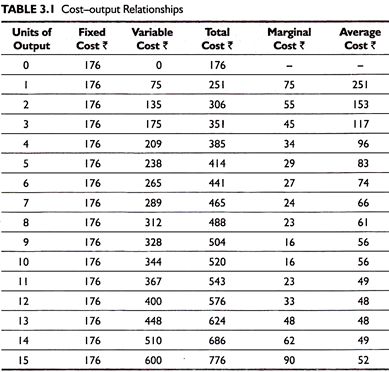
A study of the above table reveals the following points:
one. Boilerplate cost is equal to total cost divided by the number of units produced. For instance, at an output of 13 units, the total cost is Rs.624. Here the average cost is Rs.48.
two. The total toll is equal to the sum of fixed cost and all the marginal costs uncured. For example, at an output of v units, the total cost is initial toll to which the firm is committed irrespective of the quantity produced.
3. Where marginal toll falls, full cost will be rise at a failing rate; on the other mitt, where marginal cost is rises, total cost volition rise at an increasing charge per unit.
4. When marginal price is lower than the average cost, boilerplate cost will autumn; for case, up to 12 units of output as shown in Table iii.1. This volition be and then irrespective of the fact whether the marginal toll is ascension or falling. For example, for an output of 11 and 12 units, the marginal toll rises, but the average cost falls.
5. Where the marginal price is greater than the average price, the average cost will rise; for instance, for outputs at 14 and 15 units.
6. If the marginal cost starting time falls and then rises, i.e., the marginal toll curve is U-shaped, the marginal cost will exist equal to the average cost at a point where the average cost is the minimum. For example, at an output of xiii units, the average cost is the lowest at Rs.48 where the marginal price is also Rs.48.
7. If the marginal toll is below the average variable cost, the latter will autumn. This is exemplified in Table three.i upwardly to 11 units of output.
eight. If the marginal cost is higher than the average variable cost, the latter must be ascent. This is exemplified in Tabular array 3.1 at output levels of 13, 14, and 15 units.
ix. If the marginal price first falls and then rises, information technology will be equal to the boilerplate variable cost at a point where the average variable price is the minimum. This is so at an output level of 12 units where the marginal toll and the average variable toll are equal to Rs.33.
Exam Question # Q.4. What are the types of Postponable Costs :
Ans. Those costs which must be incurred in order to go on operations of the house are urgent costs – for example, the costs of materials and labor which must be incurred if production is to have identify.
Costs which tin can be postponed at least for some time are known as postponable costs, e.g., maintenance relating to building and machinery. Railways commonly brand utilise of this distinction. They know that the maintenance of rolling stock and permanent manner tin exist postponed for some time.
1. Out-of-Pocket and Book Costs:
Out-of-pocket costs refer to costs that involve current cash payments to outsiders. On the other hand, book costs, such as depreciation, practise not require electric current greenbacks payments.
Book costs can be converted into out-of-pocket costs by selling the assets and having them on hire. Hire would and then supplant depreciation and interest. While undertaking expansion, book costs practise not come into the picture until the assets are purchased.
ii. Escapable and Unavoidable Costs :
Escapable costs are costs that can exist reduced due to a wrinkle in the activities of a business enterprise. It is the internet effect on costs that is important, not only the costs directly avoidable by the contraction. Unavoidable costs, such as labor charges, ability, etc., are necessary to run the organization.
Escapable costs are dissimilar from controllable and discretionary costs. The latter are like chopping off the additional fat and are non directly associated with a special curtailment decision.
3. Replacement and Historical Costs :
Historical price means the cost of a constitute at a price originally paid for it. Replacement cost means the price that would accept to be paid currently for acquiring the same found. For instance, if the price of a machine at the fourth dimension of purchase, say, in 2010 was Rs.fifteen,000 and if the present toll is Rs.85,000, the original cost of Rs.15,000 is the historical cost while Rs.85,000 is the replacement toll.
4. Controllable and Non-Controllable Costs :
The concept of responsibility accounting leads directly to the classification of price as controllable. The controllability of a price depends upon the levels of responsibility nether consideration. A controllable toll may be divers every bit i which is reasonably subject to regulation by the executive with whose responsibility that toll is being identified. Thus, a price which is uncontrollable at 1 level of responsibility may be regarded as controllable at some other, ordinarily higher level.
Direct textile and straight labor costs are commonly controllable. As regards overheads, some costs are controllable and others are not. Indirect labor, supplies, and electricity are usually controllable. An allocated price is not controllable.
Exam Question # Q.5. What is the difference between Perfect Contest and Pure Competition ?
Ans. Perfect contest is ofttimes distinguished from pure competition, merely they differ simply in degree. The first four conditions chronicle to pure competition while the remaining 3 conditions are also required for the being of perfect competition. Co-ordinate to Chamberlin, pure contest means "competition unalloyed with monopoly elements," whereas perfect competition involves "perfection in many other respects than in the absenteeism of monopoly".
The practical importance of perfect contest is not much in the present times for few markets are perfectly competitive except those for staple nutrient products and raw materials.
Though the real world does non fulfill the condition of perfect competition, still perfect contest is studied for the simple reason that information technology helps us in understanding the working of an economic system, where competitive behaviour leads to the best allocation of resources and the most efficient organisation of production. A hypothetical model of a perfectly competitive manufacture provides the basis for appraising the bodily working of economical institutions and system in any economy.
Test Question # Q.6. What do you mean by Monopoly , Pure Monopoly and Bilateral Monopoly :
Ans. Monopoly:
Monopoly is a marketplace state of affairs in which there is only one seller of a product. The product has no close substitutes. The cantankerous elasticity of need with every other product is very low. The monopolized product must be quite singled-out from the other products so that neither toll nor output of any other seller can perceptibly bear upon its cost-output policy. 'Inter alia' it implies that the monopolist cannot influence the toll-output policies of other firms. Thus he faces the industry demand curve, his house being an industry itself.
The need bend for his product is, therefore, relatively stable and slopes downward to the right, given the tastes and incomes of his customers. He is a cost-maker who tin can set the cost to his maximum advantage. However, it does not mean that he can ready both price and output. He tin do either of the ii things.
His cost is determined by his demand curve, once he selects his output level. Or, once he sets the price for his production, his output is adamant by what consumers will take at that price. In any state of affairs, the ultimate aim of the monopolist is to have maximum profits.
The type of monopoly described above is simple or imperfect monopoly. In that location is also pure, perfect or absolute monopoly to which nosotros refer now. Simply we shall be concerned mainly with detailed discussion of simple monopoly and discriminating monopoly.
Pure Monopoly :
In pure monopoly one firm produces and sells a product which has no substitutes. The cross elasticity of demand with every other product is nil. In Triffins words, "Pure monopoly is that where the cross-elasticity of demand of the monopolist's production is Zero." The monopolist has absolutely no rivals. His price-output policy does not influence firms in other industries. Nor is he affected by others.
Pure monopoly "occurs when a producer is so producer is and so powerful that he is always able to take the whole of all consumers' incomes whatever the level of his output. This will happen when the boilerplate revenue curve for the monopolist's house has unitary elasticity (is a rectangular hyperbola) and is at such a level that all consumers spend all their income on the firm's product whatever its price.
Since the elasticity of the house'due south average revenue bend is equal to i, total outlay on the firm's production will be the same at every price. The pure monopolist takes all consumers' incomes all the time."
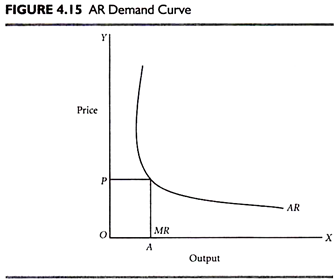
In Fig. 4.xv, AR is the need curve facing the pure monopolist. Since AR is a rectangular hyperbola, MR coincides with the Ten-axis. The monopolist tin can fix either toll or output. If he fixes OP price, so the level of output OA to be sold is determined past his customers. If he fixes his output at OA, then price OP to be paid for that is as well decided by the customers. Thus even a pure monopolist with no rivals at all cannot fix both toll and output at the same time.
Since a pure monopolist earns the whole income of the community all the fourth dimension, he will maximize his profits when his total costs are the lowest. Information technology implies that his profits are the maximum when he sells a very small output, merely i unit of measurement at a very high toll and in the process takes away the entire income of consumers. This is, however, not possible. So, pure monopoly is only a theoretical Possibility. It has never existed and will never exist. We, therefore, pass on to the study of price-output policies nether unproblematic or imperfect monopoly.
Bilateral Monopoly :
Bilateral monopoly refers to a market situation in which a single producer faces a single buyer. The seller considers himself a monopolist. And so does the buyer. The problem of bilateral monopoly has two facts. The outset refers to isolated substitution between two individuals completely cut off from other people.
"Price formation in the case of isolated exchange", as stated by Edge worth, "is essentially an indeterminate problem, which is not soluble because there is an undecidable opposition of interests as each aims at the maximization of his coin proceeds." The second relates to the case of a single producer selling a raw material product to a unmarried heir-apparent who is besides a monopolist in selling the finished product. Cournot offered a determinate solution to this case.
Suppose A is the single producer of bauxite, who sells it to B, who manufactures aluminium and sells information technology in a monopoly market. In Fig. 4.22 D is the market demand curve of B, the single buyer. D and MR are, therefore, the demand and marginal revenue curves of A, the unmarried seller. MCa is the marginal price curve of the single seller A which cuts the MR curve at E. The seller monopolist would similar to sell OM1 output at MiSouth toll in gild to maximize his profits.
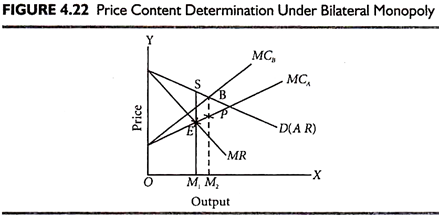
Information technology is causeless that A regards B every bit ane of the many buyers in a competitive marketplace. Similarly B considers A as a competitive seller. It implies that each acts autonomously so that the MCA curve is both the marginal cost curve and the supply curve.
To maximize his profits the buyer monopolist will have a curve MCB marginal to the MCA bend to run across his need curve D at B. He would thus be prepared to pay M2P price for OMii quantity. The toll Chiliad2p is determined by the equality of B'south marginal cost with A'south potential supply curve MCA. Information technology leads to clash of interest because the monopoly heir-apparent wishes to pay less cost (M2P < ThouiS) and demands more than quantity (OM2 > OMone) than what the seller monopolist is prepared to accept an offer. Thus, cost and quantity are indeterminate.
Cournot, notwithstanding, offered a determinate solution to this problem. According to him both the seller and the buyer monopolists would take and pay M1South toll for OM1 output considering it is at this level that they maximize their profits; the seller monopolist from the heir-apparent monopolist and the buyer monopolist from the purchasers of the finished production aluminum.
But Cournot's solution is not regarded as correct, for the buyer monopolist possesses dual monopoly. On the 1 manus, he has the monopoly of buying bauxite and on the other, of selling aluminium. He would, therefore, endeavour to excerpt monopoly turn a profit from two sides. Naturally, his intention would be to pay a low price MtwoP and buy a larger quantity OM2 of bauxite.
The seller monopolist on his part would wish to sell a smaller quantity OM1 at a higher cost OMtwo. The price-quantity situation is thus indeterminate and will prevarication somewhere between Chiliad1S and MiiP price and OM1 and OM2 quantity. Indeterminacy does not imply that there is no equilibrium position and no merchandise takes place. Rather it means that the determinate solution to the problem of bilateral monopoly is beyond the tools of economical analysis.
Exam Question # Q.7. What are the two adjustments of Long Period Monopoly Price ?
Ans. Long-run monopoly adjustments are of two types:
one. Single establish and
ii. Multi-plant adjustments
one. Single-Plant Adjustment:
If the monopolist operates on a single plant in that location may exist iii possibilities – (i) If in the brusque-run the monopolist is incurring losses, he may make such adjustments in his constitute every bit to terminate losses in the long-run. He may accept a less than the optimum size plant in order to earn profits. If he cannot, he volition take to stop production altogether (2) He may accept a establish larger than the optimum size.
This plant is, however, of less than the optimum size, for the monopoly business firm is not producing at the lowest indicate of the LAC curve 50. It has some backlog capacity. It is not in a position to take full advantage of the economies of calibration due to the small size of the market for his product.
In the second case the monopolist is in short-run equilibrium where he is maximizing his profits. In the long run, he changes the scale of his constitute in social club to earn larger profits. Accordingly, he builds the plant past adjusting its scale of plant in the long run, the monopoly firm has been able to sell more at a lower price and earn larger profits than in the short-run.
In the third instance, if the monopolist tries to install a plant larger than this optimum scale plant, he will lose instead of gaining more than by producing a larger output. The expansion of output beyond the optimum level would atomic number 82 to diseconomies of production. It implies that producing across the optimum output will lead to higher per unit price.
2. Multi-Plant Adjustments:
A monopolist may operate more than than one establish. In the brusk-run, he can operate any number of plants of the same size or of different sizes. But in the long-run, he operates simply those plants which together bring in larger profits. Given each found of the aforementioned size and of identical cost conditions, he will have each constitute of that size where the long-run average cost curve LAC and the SAC bend touch each other at their minimum points.
If in the short-run, the monopolist operates four plants, he may reduce them to two in the long-run by employing more efficient plants so that the long-run average and marginal costs are lowered and he earns larger profits. Like the unmarried plant monopoly, the multi-institute monopoly adjustment in the long-run may be followed by quantity and price changes. Only in the instance of multi-constitute monopoly the business firm will operate at the minimum long-run boilerplate costs to proceeds maximum profits.
Examination Question # Q.8. What do you hateful past Joint Hindu Family unit Firm ?
Ans. In India a large number of business are carried on in the shape of Joint Hindu Family (JHF) which are in essence individual entrepreneurs possessing almost all the advantages and limitations of sole proprietorship. A JHF comes into being by the operation of police. If the business commenced past a person is carried on past male members of his family after his death, it is a case of JHF.
Except in West Bengal where Dayabhaga system of Hindu Law is prevailing, in the residuum of Bharat Mitakshara system of inheritance is in operation according to which three successive generations in the male line simultaneously inherit the ancestral property from the moment of their birth. Thus son, grandson, and corking grandson become joint owners of ancestral holding by reason of their nativity in the family.
They are called co-partners in interest. The Hindu Succession Act, 1956, has extended the line of co-partners interest to female relatives of the deceased partner or male relative claiming through such female person relatives. The family business organization is included in heritable property and is thus the bailiwick of co-partenary interest. Under the Dayabhaga Police force, the male heirs go members only on the decease of the father.
Begetter or the other senior family member manages the business organisation and is chosen Karta or Manager; other members take no correct of participation in the management. The Karta has control over the income and expenditure of the family and is the custodian of the surplus, if whatever. The other members of the family cannot question the authority of the Karta and their only remedy is to get the JHF dissolved by mutual agreement.
If the Karta has misappropriated the funds of the business, he has to compensate the other co-partners to the extent of their share in the joint property. The Karta can borrow funds for conducting the business organisation but the other co-partners are liable only to extent of their share in the business. In other words, the liability of the Karta is unlimited.
A Joint Hindu Family can enter into partnership with others. But outsiders cannot get members of the JHF. The decease of a fellow member does not deliquesce the business organization or the family. Dissolution of the Joint Hindu Family is possible only through common understanding. The male person adult members can need partition of the belongings of the JHF. On separation, a co-partner has no right of asking for previous accounts.
Examination Question # Q.nine. What are the advantages and disadvantage of Joint Hindu Family unit Firm?
Ans. Some of the advantages of Joint Hindu Family unit firm are every bit follows:
1. Every co-partner is guaranteed a "bare subsistence" irrespective of the extent of his contribution to the business concern.
2. There is a telescopic for younger members of the family unit to go the benefit of knowledge and experience of elderberry members of the family unit.
3. Members of the family unit are taught to piece of work not simply for their own benefit merely too for the benefit of entire family without being selfish.
4. Sick, unemployed, quondam, bodily infirm, widows, and orphan family unit members are looked later on by the other members of the family with due care.
5. This form of system provides an opportunity to develop virtues of discipline, cocky-sacrifice, and co-functioning.
6. Benefits of "division of labor" tin can be secured by assigning the work to members of the family as per their specialization.
7. Equally "Karta" enjoys full freedom in conducting family business, he can have quick business decisions and also tin can run the business without interference by others.
8. Equally the liability of the "Karta" is unlimited, he takes maximum interest in business organisation in order to manage it on the virtually efficient lines.
Disadvantages :
As against the above advantages, the Joint Hindu Family business firm suffers the following disadvantages:
1. There is no encouragement to work hard and earn more, because members who piece of work difficult are not properly rewarded and all the co-partners irrespective of the piece of work turned out by them share the benefit of their hard piece of work.
ii. As "Karta" takes the responsibility to manage the firm, the other members of the family unit may go lazy and inactive.
3. The "Karta" exercises full control over the unabridged business, and other co-partners accept no correct to interfere in the management of business organisation, then this hampers the initiative and enterprise of individuals.
4. More often than not, the elder members of the family may non approve the views of the younger members of the family. This leads to disharmonize betwixt old and immature members of the family and may result in the partition of the business.
5. Karta may misuse his freedom for his personal benefits as other co-partners accept no correct to interfere in conducting business.
Evaluation :
This form of business organisation is losing ground with the gradual cease of the Joint Hindu Family system. It is being replaced either by sole proprietorship or partnership business firm.
Exam Question # Q.10. What is the difference betwixt Partnership and Joint Hindu Family Firm ?
Ans. Though both partnership and Articulation Hindu Family firm are organized by groups of persons, there are some bones points of distinction arising from the different laws governing them.
The post-obit are the points of stardom between these two:
1. Partnership firm tin only arise equally a result of contract between the partners. But a Joint Hindu Family business is the creation of law; the members of the joint family become co-partners by virtue of their status.
2. A partnership is governed by the Indian Partnership Act, simply a Joint Hindu Family business concern is governed by the Hindu Constabulary.
three. In the case of partnership, women can become the members of the partnership concern but in the instance of Joint Hindu Family unit business only male members can get co-partners. However, under Dayabhaga organisation of Hindu Law which is prevailing in Due west Bengal, female members tin can become co-partners under sure circumstances.
four. In the case of partnership firm, a minor cannot become a full-fledged partner, but in the case of the Joint Hindu Family unit business fifty-fifty a pocket-size becomes a copartner from the moment of his nascence.
five. A partnership becomes illegal if the number of partners exceeds 10 in the case of banking business concern and 20 in the case of other business concern. But in the instance of Joint Hindu Family business there is no maximum limit to the number of members.
6. In the instance of partnership firm, though registration is not compulsory, usually all the firms are registered to get some benefits of registration. In the example of Joint Hindu Family business organization registration is non at all compulsory.
seven. In partnership the death of a partner dissolves the partnership, merely the Articulation Hindu Family business is non affected by the death of a co-partner. Both partnership and Articulation Hindu Family concern can exist dissolved through mutual agreement.
8. Every partner tin take part in the direction of the partnership business organization and whatsoever partner can bind his other partners by acts done in the ordinary form of the partnership business. But in the case of Joint Hindu Family business organisation, merely the Karta, the senior most fellow member of the family, has the unsaid potency to manage the business and to bind the joint family unit business organization for all the acts done in the ordinary course of the concern.
The Karta or Manager enjoys broad powers to borrow money, enter into contracts, mortgage or sell avails, or take any other activity for the legitimate interest of the business organisation.
9. The liability of partners in partnership concern is joint and several to an unlimited extent. But in a Joint Hindu Family business the liability of every member except that of the Karta is limited to his interest in the joint belongings. The liability of the Karta is unlimited and the creditors of the firm tin can recover their debts even by selling the Karta's personal backdrop.
ten. The resource allotment of shares of partners in the partnership business organization is determined by the mutual agreement, and change in the shares of partners tin accept place just with the mutual consent of all the partners. In a Joint Hindu Family business, every co-partner enjoys equal share in the family business but the share of each member may fluctuate; it increases with the death of an existing co-partner and diereses with the nascence of a new one.
11. If a partner dies, his interest in the partnership devolves on his heirs, whether they are admitted as partners or not. Simply in a Articulation Hindu Family business concern, if a co-partner dies the undivided share of the debased co-partner devolves on the surviving co-partners and not on the heirs of the deceased by succession.
12. A partner in a partnership business firm, after severing his connections, tin can inquire for accounts of by profits and losses but it is otherwise in the instance of a co-partner.
Examination Question # Q.11. What are the Problems Faced by Public Sector Enterprises?
Ans. Some of the important problems of the public sector enterprises stated above have been analyzed here and if these problems could be tackled, certainly nosotros can wait a much higher charge per unit of return on the investment in the public undertakings.
i. Poor Projection Planning:
Due to several mistakes, flaws, and omissions in projection planning, many of the public enterprises take longer time to complete, which results in increasing the price of the project and considerable delay in their completion. For instance, the commissioning of the Tomboy project delayed by 3 years, Barony Refinery by 2 years and Antibiotic Factory at Hardware past 1 yr. To overcome this drawback, adequate feasibility studies and detailed planning should exist undertaken.
ii. Bad Financial Planning:
The financial planning of many public sector enterprises likewise suffer from several drawbacks due to which they face the problem of overcapitalization. Co-ordinate to the study squad of the Authoritative Reforms Commission, many undertakings such as Hindustan Aeronautics, Heavy Technology Corporation, Heavy Electrical, Fertilizer Corporation, and Indian Drugs and Pharmaceuticals were found to exist over-capitalized.
The various reasons that accept contributed for over-capitalization are the inadequate planning, surplus capacity, delays in structure, heavy investment on housing and labour welfare, and bad location of projects.
iii. Heavy Overheads:
These enterprises have incurred huge expenses for the provision of amenities to the employees and townships to conform them. It is estimated that the average investment in township accounts to about xx% of the toll of a projection.
iv. Faulty Production Planning:
Lack of proper production planning in these undertakings has resulted in the nether-utilization of capacities leading to heavy losses. Farther, there is absence of proper materials and inventory management and as well budgetary and inventory controls. All these have affected the efficiency and the rate of return on investment.
v. Poor Manpower Planning:
Because of working estimation of manpower requirements, over-staffing is a common feature of all public enterprises leading to increase in wage beak and operating costs considerably. The Administrative Reforms Committee has observed that "a comparing of the forecast made in the detailed project report of various steel plants, fertilizer project, heavy electric found, etc., shows the actual staff strength is much in excess of that estimated in the project reports."
vi. Poor Labor Management Relations:
In a majority of these undertaking industrial relations are far from satisfactory in spite of the fact that the huge sums have been spent for providing amenities to the employees. This resulted in strikes and lockouts leading to autumn in output and increase in the toll of production.
seven. Problem of Personnel:
The salary and wage scale of the personnel of these undertakings are comparatively low than private sector undertakings and due to this capable people are non available. The method of recruitment and preparation is also outdated and faulty. Farther, these undertakings continue to depend on deputationists from the core of civil servants for filling the middle- and peak- level posts. These civil servants lack business apprehending and experience, which are essential for efficient direction of the undertakings.
viii. Lack of Autonomy of Management:
The regime, the government minister concerned, and the Parliament interfere in the twenty-four hour period-to-day working of these enterprises and due to this interference, it has become difficult for these undertakings to run on sound business principles. For managing the units efficiently, there is demand to run them on business principles and further they should be given a large measure of autonomy in the day-to-24-hour interval administration.
One of the methods adopted past the authorities to better the management is to establish property companies to take over the management of some public sector undertakings. The government has already established a holding company, Steel Say-so of India Ltd. (Sail), to administer the steel units in the public sector. It has already shown good results.
In conclusion a reference may be made to the policy proposed in the 4th Five Year Program in relation to the functioning of public sector enterprises. The policy is linked with action proposed in two separate directions. First is in the direction of much greater co-ordination and integration. Though investments in the public sector have been large and their composition varied, the different units within the sector do not human activity sufficiently in concert.
Information technology is suggested that this defect can be removed past creating appropriate machinery for constructive co-ordination. When this happens, the plans of private units will get more purposeful and their operations efficient. Secondly, information technology is proposed that detailed decision-making in the individual units should be finer decentralized. This is a specifically stated objective of government policy, which has notwithstanding to be attained.
Exam Question # Q.12. What are the Administrative Problems of Land Enterprises?
Ans. Since independence, a large number of State enterprises have been established and the State has been facing the problems relating to their administration. The various experts' committees that were constituted to advise the government on the direction of Land enterprises take given divergent and over-contradictory views.
Still, they take thrown some light on the nature of issues and accept given some valuable suggestions. Without going into the details of the suggestions fabricated by the diverse experts' committees, a general reference to some aspects of administrative issues of State enterprises may be made here.
one. Choice of a Form of Organization:
In India, company grade of organizations have been found favorable with the regime as against the consensus of experts for public corporation. The reasons for favoring visitor course of organisation are as follows – (i) the opportunity that it provides for attracting private investment, both domestic and foreign; and (ii) the executive arm of the authorities did non want the public to get the total information about the undertaking which is the instance if it were a public corporation.
Prof. Galbraith in 1956 and the Estimates Committee in 1960 have recommended the establishment of larger companies in society to derive the benefits and economies of large-scale organization and management. A beginning has already been made in this corporation, the Hindustan Steel Limited, Fertilizer Corporation, and the Harvey Electric Limited.
2. Management:
The lath of directors appointed to diverse public undertakings are nominated by the government, mostly from the government officials of the various departments The Estimates Committee has felt that these directors cannot play whatever useful role. It has, therefore, suggested that the membership of the lath should exist closed to the officials of the departments, members of parliament, and ministers.
Krishna Mennen Committee has suggested that the directors should be drawn from the ranks of the visitor and should consist of financial talent, technical skill, administrative talent, and representatives of labor.
3. Autonomy:
The Estimates Committee has pointed that in Bharat State undertaking are often treated as departments and offices of the authorities which are subject to all the usual cherry-red tape and procedural delays. This greatly affects the productive action of the undertakings. They should be run on business organisation principles and there should not be interference by the Ministers on the pretext of regulating them.
The need for autonomy of management for State enterprise has been emphasized by E.C.A.F.Due east. Seminar as well every bit past other experts' committees, which were constituted to examine the working of public enterprises.
4. Internal Administration:
One important problem faced by the Land enterprise is the lack of trained personnel to manage them. At nowadays the managing directors are by and large the senior officers of the authorities departments who do not possess technical cognition and experience.
The problem of personnel can be solved either past straight recruitment of young men through special recruitment boards or by drafting people with adept record in the private sector. It is gratifying to note that recently it has been decided to create industrial management service for staffing enterprises in public sector.
5. Parliamentary Control:
Every bit the State enterprises are ready mainly to render service to lodge and safeguard its interest, information technology is necessary that parliament should practice some control on their working. The parliament has to encounter that – (a) the consumers are provided with quality appurtenances and service at reasonable prices and (b) interest of labor is protected.
Parliamentary control over the Country undertakings is exercised by the methods such every bit – (a) questions in parliament, (b) debates on the almanac grants of the various ministers, (c) Annual reports on the government companies, and (d) Public Accounts Committee and the Estimates Committee reports.
At that place can exist no objection to parliament's control of Land enterprises in which huge public funds are involved. However, it is necessary for parliament to permit a certain amount of flexibility in regard to control to exist exercised from time to time.
6. Pricing Policy:
Another of import problem faced by the administrators of public enterprises is improper pricing policy. While formulating a price policy for public enterprises, the administrators accept to bear in listen many circuitous considerations such as generation of surplus for reinvestment, nature of demand for the products, purchasing power of consumers, policy of the State, attainment of the optimum level of production, competition from private enterprise and from foreign producers, availability of substitutes, etc.
Economists also are not unanimous in their opinion regarding the pricing policy of public enterprises. While some economists advocate that public enterprises should function in the public interest on a no-turn a profit-no-loss basis, some others have stated that the public enterprises should exist able to generate enough surpluses both for their requirements of growth, replacements and development, too every bit for financing other developmental plans included in the Five Year Plans.
In this connection nosotros may annotation that the Administrative Reforms Committee's Study Team on Public Undertakings recommended that our public enterprises should pursue a pricing policy that ensures non merely that the toll is covered simply also the financial requirements of other developmental plans of the country can exist financed through their surpluses.
In accordance with the recommendations of the written report team, the Quaternary Plan gave a full general management to all public enterprises to aim at a charge per unit of return of not less than xi-12 per cent.
rhoadshustend1977.blogspot.com
Source: https://www.economicsdiscussion.net/exam-questions/top-12-exam-questions-and-answers-on-economics/31183
0 Response to "Discussion Questions for Economic Article Review in Forbes"
Post a Comment